LinkedIn Lead Gen Forms vs. Landing Pages: The B2B Decision Framework
Lead Gen Forms win on volume. Landing pages win on quality. The question is which one you actually need right now.

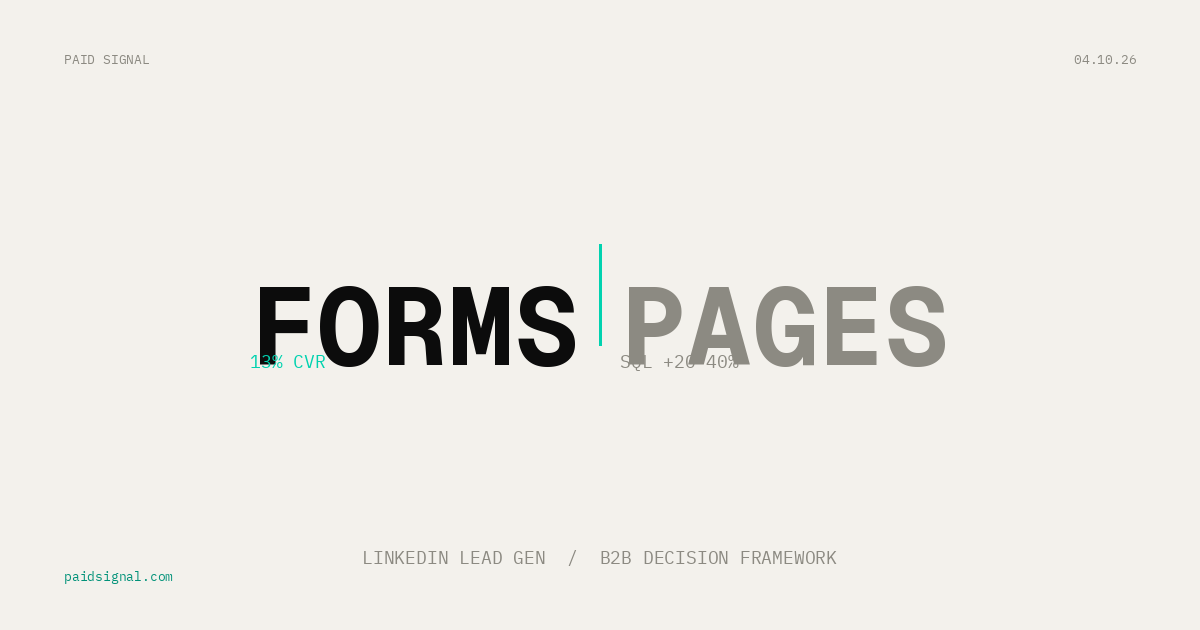
LinkedIn Lead Gen Forms convert at 5-10+ percent. Standard landing page campaigns on LinkedIn convert at 2 to 4 percent. That gap looks compelling on a CPL report and terrible in a pipeline review.
Lower cost per lead is only valuable if the leads produce qualified pipeline. For B2B, the metric that actually matters is cost per opportunity and ultimately CAC. Lead Gen Forms frequently win on CPL and lose on both. Switching from landing pages to Lead Gen Forms often reduces cost per lead by 30 to 50 percent while simultaneously dropping opportunity rates enough that you are spending more to source each deal, not less.
The form that is easiest to complete captures the most volume. It does not capture the most intent. Someone who tapped Submit on an autofilled form while scrolling their feed is not the same buyer as someone who navigated to your landing page, read your positioning, and submitted anyway. Both show up in your leads column. Only one tends to show up in your pipeline.
Both formats have a legitimate place in a B2B LinkedIn program. The decision is which one belongs at which stage and for which offer.
Why Lead Gen Forms Convert Higher
LinkedIn Lead Gen Forms keep the user on the platform. When someone clicks your ad, a form opens with their LinkedIn profile data pre-filled: name, email address, job title, company, and phone if they have added it. They tap submit. Done. No landing page, no browser load, no re-entering information they have typed a hundred times.
On mobile, this difference is significant. Landing pages on mobile are slower, more prone to form field friction, and more likely to result in drop-offs before submission. Lead Gen Forms remove all of that. The user never leaves LinkedIn.
The pre-fill also removes a friction point that has nothing to do with intent: people abandon forms because they cannot remember their work phone number, because they are on mobile and do not want to type, or because the form asks for information they consider unnecessary. Lead Gen Forms eliminate that class of abandonment entirely.
The result is a higher conversion rate on the same audience. The leads you gain over landing pages are people who had mild interest and low friction, not people with high intent who were blocked by a difficult form.
Why Landing Pages Qualify Better
A landing page asks the user to leave LinkedIn, wait for a page to load, and manually fill out a form. That friction filters out low-intent contacts before they ever reach your CRM.
Someone who clicks through to your landing page, reads your content, and submits a form has demonstrated more active intent than someone who tapped Submit on an autofilled form while scrolling their feed. The extra steps are not a flaw. They are a self-qualification mechanism.
Landing pages also give you something Lead Gen Forms do not: context delivery. A well-built landing page can present your positioning, your customer proof, your pricing signals, and your offer before asking for contact information. A buyer who submits after reading all of that is further along in their decision process than one who submitted after seeing a 150-word ad.
For offers where the buyer needs context to make a decision worth the effort, landing pages produce better-quality submissions. For offers where the value is simple and immediate (a benchmark report, a webinar registration, a free assessment), that context is less necessary and Lead Gen Forms win on efficiency.
The Offer Decides More Than the Format
The biggest driver of Lead Gen Form vs. landing page performance is not the platform or the targeting. It is the offer.
Offers where Lead Gen Forms are the right format: content downloads (benchmark reports, guides, templates), webinar registrations, newsletter signups, free tool access, event registrations. These offers have clear and immediate value, low commitment, and do not require the buyer to understand a complex proposition before submitting. The form completion is the conversion.
Offers where landing pages are the right format: demo requests, trial signups, assessment or audit requests, pricing discussions, enterprise sales contact forms. These offers imply a sales conversation. The buyer needs to understand what they are agreeing to before they engage. A landing page that explains the demo format, shows a customer quote about the process, and sets expectations for what happens after submission produces better-qualified demo requests than a Lead Gen Form that captures a name and email and promises "someone will be in touch."
When the conversion event downstream of the form is a sales call, give the buyer enough information to pre-qualify themselves before they submit.
The Budget Split That Works for Most B2B Programs
Most B2B LinkedIn programs benefit from running both formats in parallel, allocated by funnel stage.
For top-of-funnel awareness campaigns targeting cold audiences with content offers, Lead Gen Forms are the right format. The offer is low-commitment (a guide, a report, a webinar), the buyer does not need to pre-qualify themselves before submitting, and you want maximum reach per dollar. Lead Gen Forms reduce friction without sacrificing meaningful qualification signal at that stage because the conversion event itself is not the thing you are selling.
For bottom-of-funnel campaigns targeting warm audiences, accounts in active sales cycles, or retargeting lists from prior engagement, landing pages are the better format. The buyer is further along in their decision process. The additional friction filters for intent, the page can deliver context that improves the quality of the conversation downstream, and the gap in conversion rate between formats narrows as audience intent increases. The CAC math usually favors landing pages at this stage even when CPL is higher, because the opportunity rate is meaningfully better and sales spends less time disqualifying.
A starting allocation: 60 to 70 percent of LinkedIn budget through Lead Gen Forms for TOFU content offers, 30 to 40 percent through landing pages for MOFU and BOFU conversion events. Adjust based on cost per opportunity data over 60 days, not cost per lead.
The Lead Quality Problem and How to Fix It
The most common Lead Gen Form complaint from B2B sales teams: the leads are low quality. People submit because it was easy, not because they were interested. The form captured an email address that goes to a Gmail account, a job title that says "Student," or a company that has nothing to do with the ICP.
Three fixes.
First, add a qualifying question to your Lead Gen Form. LinkedIn allows custom questions alongside the pre-filled profile data. One well-chosen question (company size, current technology in use, specific challenge they are trying to solve) filters out contacts who are not a fit before the lead reaches your CRM. It also reduces conversion rate slightly, which is acceptable if it improves opportunity rate downstream.
Second, use Hidden Fields to capture the campaign ID and the ad creative ID on every Lead Gen Form submission. When you see patterns in which campaigns produce better opportunities, you can reallocate budget toward those targeting configurations and creative approaches. Without this data, you are averaging quality across all sources and cannot identify what is actually working.
Third, feed Lead Gen Form opportunity data back to LinkedIn via Conversions API. When LinkedIn knows which of its Lead Gen Form submissions eventually became qualified opportunities, it can optimize toward finding more people with that downstream profile. This is the step most teams skip, and it is the one that separates Lead Gen Forms that produce pipeline from Lead Gen Forms that produce lead volume. Without it, LinkedIn is optimizing for submissions. With it, LinkedIn is optimizing for the buyers who actually matter to your CAC.
What to Test This Week
Two steps.
Step 1: Identify your highest-spend LinkedIn campaign that is currently using website traffic or landing page conversion objectives. Pull the opportunity rate and cost per opportunity from your CRM by source. This is your baseline. If you do not have opportunity data by source, that is the first thing to fix before running this test.
Step 2: Duplicate the campaign and switch to Lead Gen Forms. Keep the audience, bid strategy, and creative identical. Add one qualifying custom question to the form. Run both versions in parallel for 30 days with equal budget. Compare cost per opportunity, not cost per lead. If Lead Gen Forms produce a lower cost per opportunity, shift budget. If landing pages produce enough of a lift in opportunity rate to justify the CPL premium, keep the split or move more budget to landing pages.
The number that matters is not which format produces more leads. It is which format produces more qualified pipeline per dollar, and over time, which one drives better CAC.
What's changing in B2B paid media. What it means for your pipeline.