Manus AI in Meta Ads Manager: What B2B Advertisers Can Actually Do With It
Manus AI landed inside Meta Ads Manager in February 2026. Here are six use cases that work for B2B paid media teams right now and what to prepare for when execution capabilities ship.

Manus AI is now embedded in Meta Ads Manager, and the coverage has ranged from entranced to dismissive. Neither is useful.
The current integration is read-only. Manus cannot create campaigns, write copy, adjust bids, or touch your budget. What it can do is connect to your live account data and run multi-step analysis without you setting up an export first. For B2B paid media teams, that is a real productivity gain in a few specific workflows - and a non-event in others.
Here is what Manus AI in Meta Ads Manager actually does, where it saves time, and what changes when execution capabilities ship.
What Is Manus AI in Meta Ads Manager?
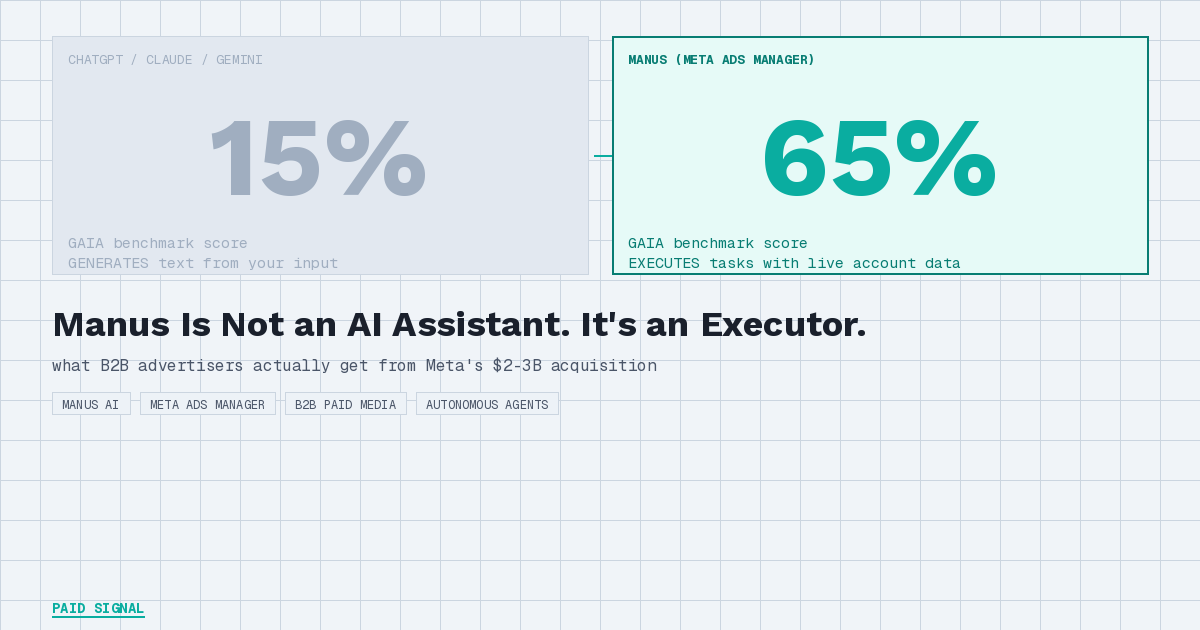
Manus is an agentic AI tool - meaning it receives a goal, breaks it into steps, and executes those steps autonomously using platform tools. Unlike ChatGPT or Claude, which require you to paste in data before they can analyze it, Manus connects to your live Ads Manager data directly.
Meta acquired Manus in late December 2025 and embedded it in the Ads Manager Tools navigation in February. The current version is scoped to analysis and reporting only. Meta has indicated execution capabilities - bid adjustments, budget reallocation, pausing underperforming ad sets - are on the roadmap.
6 Manus AI Use Cases for B2B Paid Media Teams
1. Weekly Cross-Campaign Performance Summary
Cross-campaign performance summaries used to take thirty to forty minutes. Export by campaign, pivot by ad set, compare against prior period, write the summary. Manus compresses that to a single prompt.
Ask it for a weekly summary across your active campaigns - spend, results, cost per result, variance from the prior week - and it pulls the data, structures it, and flags anomalies. For B2B teams managing five or more campaigns with weekly reporting requirements, this is the most immediate time save in the current integration.
How to use it: Prompt Manus to generate a weekly performance summary across all active campaigns. Compare the output against a raw Ads Manager export for the first few runs to verify accuracy before presenting to stakeholders.
2. Creative Fatigue Detection
B2B ads run longer than B2C. Smaller audience pools, longer sales cycles, and campaigns that stay live well past the point where frequency has degraded performance. Creative fatigue consistently gets caught late - often after CPL has already climbed.
Manus surfaces it earlier. Prompt it to identify ad sets where frequency has crossed a threshold or where CTR has declined more than a set percentage over two weeks while spend remained flat. It runs the pattern check across all active ad sets without requiring manual comparison.
What to do with the flagged ad sets - refresh creative, rotate variations, adjust the offer - still requires judgment that Manus does not have. But finding them is faster. For the full breakdown on how Creative Similarity and fatigue scoring affect your CPMs, see Meta's new creative health metrics for B2B advertisers.
3. Audience Overlap Analysis
Before launching a new campaign targeting a segment already in market, knowing how much overlap exists with active audiences affects both reach and CPM. Running this manually means exporting audience definitions and estimating reach loss by hand.
Manus runs this analysis inside the platform using live data. Prompt it to flag where reach duplication between two audience segments is likely to inflate CPMs or suppress delivery. For B2B teams running ABM-style campaigns with multiple overlapping account lists, this saves meaningful setup time when adding campaigns against similar audiences.
4. Daily Spend Pacing Alerts
Budget pacing problems compound before they get noticed. A campaign underspends for two days, the algorithm resets its learning phase, and an entire week of budget efficiency is lost. Overpacing on a high-CPM day pulls from campaigns that needed the spend more.
Manus can run a daily pacing check across all active campaigns. Prompt it to flag any campaign more than 15% ahead or behind expected daily pacing and identify which ad sets are driving the variance. Built into a morning workflow, this prevents the slow drift that accumulates across a full campaign flight - and it is the kind of check that gets skipped when the week is busy.
5. Landing Page Audit Against Ad Performance
One of the most underused applications: using Manus to cross-reference ad performance data with landing page behavior. Ask it to pull campaigns where CTR is strong but conversion rate is low - the gap between click volume and result suggests the landing page or offer is the bottleneck, not the ad.
Manus cannot access your landing page or CRM directly. What it can do is isolate the ad sets where in-platform performance diverges from on-site conversion signals passed back via pixel - surfacing the campaigns where post-click is the constraint. That narrows the diagnostic from "something is wrong" to "the problem is after the click," which is a more useful brief for the team responsible for the page.
For B2B teams where driving traffic to a demo request or gated asset is the primary conversion event, this use case surfaces the campaigns worth a landing page review before reallocating budget toward them.
6. Tool Integration Readiness Check
Manus can audit your Ads Manager setup against integration dependencies - CAPI configuration, pixel events, conversion API completeness, UTM parameter consistency across active campaigns. These are the structural checks that affect how well Meta's optimization layer performs, and they are easy to let drift as campaigns accumulate.
Ask Manus to review your active campaigns for missing or misconfigured conversion events, inconsistent UTM parameters, or ad sets that are not firing the right pixel events for their stated objective. It surfaces the gaps without requiring a manual account audit. If your CAPI configuration needs a full setup, here's how to wire Conversions API for B2B lead campaigns.
For B2B advertisers connecting Meta to a CRM or revenue attribution tool, this is a useful pre-launch check before running any new campaign that depends on downstream data passing correctly into your reporting stack.
Where Manus AI Does Not Help (Yet)
Cross-channel attribution. Manus only sees what is inside Meta. B2B buyers move between LinkedIn, Meta, organic, email, and dark funnel touchpoints before converting. Manus has no visibility into that path. Cross-channel analysis still requires pulling data from multiple sources.
Post-click performance. Manus does not know what happens after the click. If Meta campaigns are driving traffic that does not convert to pipeline, Manus can confirm the CTR looked fine. It cannot identify whether the landing page, offer, or audience was the problem. That context lives in your CRM. Connecting Manus to Hubspot/SalesForce (the possibilities are endless, right?) could be a major unlock.
Strategy and copy work. General-purpose LLMs - ChatGPT, Claude - outperform Manus on tasks where the relevant context lives outside the platform. Briefing, positioning, creative development, and hypothesis testing belong to tools that do not need live ad account access to be useful.
What Happens When Manus Execution Ships
Meta has confirmed Manus will expand beyond read-only into campaign execution - bid adjustments, budget reallocation, pausing underperforming ad sets. That is when the tool becomes significantly more interesting and where B2B advertisers need to think ahead.
Execution agents optimizing inside Meta's data environment will optimize for what Meta can measure: CTR, CPL, cost per click. These are inputs to pipeline. They are not pipeline. B2B conversion cycles extend well beyond the platform - and the metrics that look best inside Ads Manager do not always correlate with the pipeline quality your sales team can actually work.
B2B advertisers who define now which decisions belong to an agent and which require human judgment will set up their execution workflows correctly when the capability ships. The practical questions to answer before then: what signal would you want Manus optimizing toward, and which account decisions need a human with access to CRM data to make?
Frequently Asked Questions
What can Manus AI do in Meta Ads Manager? As of March 2026, Manus in Meta Ads Manager is read-only. It can run cross-campaign performance summaries, flag creative fatigue signals, analyze audience overlap, check spend pacing, audit landing page performance gaps, and review tool integration setup - all using live account data without requiring manual data exports. Campaign creation, bid adjustments, and budget changes are not yet available.
Is Manus AI available to all Meta advertisers? Manus is accessible through the Tools menu in Ads Manager for most advertisers. Some accounts are seeing a paid trial prompt. Access is rolling out broadly but may not be live in all accounts yet.
How is Manus different from Meta's existing AI tools? Meta's existing Advantage+ and AI-generated creative tools operate within pre-set automation rules. Manus is an agentic tool - it receives an open-ended goal and executes multi-step analysis autonomously. It surfaces insights from live data rather than applying pre-defined optimization logic.
Should B2B advertisers use Manus AI right now? For analysis and reporting tasks, yes. The weekly performance summary and creative fatigue use cases offer real time savings for teams managing five or more campaigns. Verify the output against raw exports initially. For anything requiring judgment about pipeline quality, Manus is not the right tool - that context lives outside Meta's walls.
Start Here
Give Manus one task this week: weekly cross-campaign performance summary. Check the output against your raw Ads Manager export and see if it catches what you would have caught manually.
If it does, you have recovered thirty to sixty minutes of weekly reporting work. Redirect that time to the analysis that requires data Manus cannot access - pipeline, creative strategy, cross-channel sequencing.
Paid Signal covers what's actually changing in B2B paid media on LinkedIn and Meta. Practitioner-first, no vendor spin. Twice a week.