Meta Ads Audience Targeting for B2B Has Changed. Here Is Who It Actually Works For.
Meta no longer works the way most B2B advertisers think it does. The detailed targeting that defined the platform has been replaced by platform-controlled delivery. Here is what that means for your campaigns.

Meta no longer works the way most B2B advertisers think it does. The detailed interest and demographic targeting that defined the platform five years ago has been systematically replaced by platform-controlled delivery. Advantage+ Audience is the current expression of that shift.
For B2B teams, this changes the fundamental question from "can I target my ICP on Meta?" to "does Meta have enough signal to find my ICP at all?" Those are different questions with different answers depending on your business. Here is how to know which situation you are in.
Meta Moved From Audience Control to Audience Signals
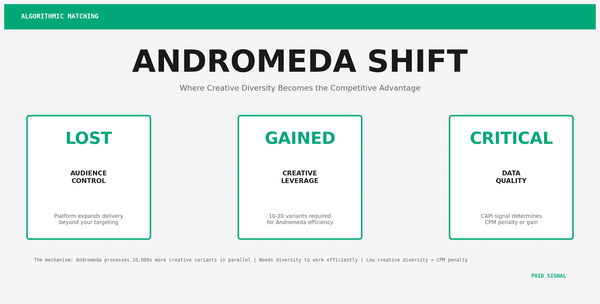
The old model: you defined the audience. Job title interests, industry behaviors, demographics, layered exclusions. Meta delivered to the box you built. You controlled the parameters. The platform executed.
That model eroded after iOS 14 created signal loss across the ad ecosystem, and Meta accelerated the shift deliberately. The new model: you give Meta signals and the platform decides delivery. Your custom audiences, CRM uploads, and pixel data become inputs. Meta's platform uses those inputs to find buyers, including people who do not match your stated parameters but behave like your converters.
Advantage+ Audience is this formalized. You can provide audience suggestions, demographics, and custom audiences as a starting point. The platform can expand beyond them if it determines broader delivery will improve results. The control tradeoff is explicit: less precision, potentially better cost per pipeline opportunity at scale.
This is not a bug. It is Meta's stated product direction. Understanding it as a deliberate tradeoff rather than a loss of control changes how you evaluate whether Meta belongs in your B2B media plan.
What Advantage+ Audience Actually Gives You
Advantage+ Audience is not a campaign type. It is an audience approach within your existing campaigns. You provide suggested audiences: a custom audience from your CRM, a demographic range, specific interests relevant to your ICP. The platform treats these as recommendations rather than hard constraints.
When it works: your CRM upload gives the platform a strong signal of what a qualified buyer looks like. The platform finds similar users outside that upload, expands into audiences you did not define, and delivers at lower CPM than a tightly constrained manual audience because it has more inventory to work with.
When it does not work: your seed data is thin or low quality, your ICP is too narrow for the platform to find meaningful look-alike patterns, or your conversion events are too far down the funnel to generate enough signal. The platform expands and finds volume, but not qualified pipeline.
The platform does not know what a qualified sales opportunity looks like in your CRM. It knows what a conversion event looks like. If your conversion event is a demo request form, the platform optimizes for demo request form fills. Whether those demo requests turn into qualified opportunities is not in its data. For B2B advertisers with long sales cycles and high deal values, this signal gap is the core limitation.
Audience Size Is the Real Filter for B2B
The platform needs volume to learn. Too small a serviceable addressable market and there is not enough signal for optimization to work. This is the practical filter most B2B audience targeting conversations skip.
A rough framework:
Under 50,000 in your SAM: Meta is a retargeting layer, not a prospecting channel. Use it to stay visible to your website visitors, event attendees, and CRM contacts. Do not run cold prospecting on Meta for an ICP this narrow. LinkedIn can reach 400 supply chain directors at mid-market manufacturers by job title. Meta cannot, and the platform expanding into adjacent audiences will find the wrong people faster than the right ones.
50,000 to 250,000 in your SAM: Meta can work alongside LinkedIn. Use LinkedIn for cold ICP prospecting where firmographic targeting matters. Use Meta for brand reach and retargeting against your CRM and site traffic. The two channels serve different parts of the funnel and do not compete for the same job.
Over 250,000 in your SAM: Meta can run full funnel. HR software, security tools, financial services, productivity platforms, fleet management, anything with a large addressable market of business buyers. The platform has enough buyers to find, CRM lookalikes are meaningful at this scale, and CPMs of $6-23 compared to LinkedIn's $30-80 make Meta genuinely cost-competitive for awareness and mid-funnel.
The retargeting exception cuts across all three: even a niche B2B company with a small SAM can use Meta effectively for retargeting if the CRM is large enough. A boutique consulting firm with 5,000 past clients and prospects can run a Meta retargeting campaign that stays in front of that known universe at low CPM. The channel works for retargeting at almost any TAM size. It works for cold prospecting only when the TAM is large enough.
The Data You Actually Need for Meta B2B to Work
The most reliable B2B targeting lever on Meta is not interest targeting or demographic layering. It is a clean CRM upload connected through CAPI.
Custom audiences built from CRM contacts give the platform a strong, first-party signal of what your buyers look like. Lookalike audiences built from those contacts extend that signal to new prospects. The quality of the lookalike is entirely dependent on the quality of the seed. A seed audience of 200 past customers produces a weak lookalike. A seed of 10,000 qualified contacts produces a strong one.
CAPI is what makes the CRM data reliable. Without it, signal loss from browser restrictions and iOS privacy changes degrades how well Meta matches your CRM upload to platform users and tracks downstream conversion events. The connection between your CRM and Meta's platform is the foundation everything else runs on. Running Meta B2B campaigns without CAPI is running on degraded signal. For more on how CAPI affects campaign efficiency, see Meta Advantage+ Leads for B2B: Why CAPI Is the Gate to the Efficiency Gain.
Retargeting audiences built from pixel events work independently of CRM quality. Website visitors, video viewers, lead form openers. These audiences are built from on-platform and on-site behavior. They do not require CRM data quality to function, which is why retargeting is the lowest-risk Meta play for B2B advertisers who are not yet confident in their CRM data quality.
Meta vs. LinkedIn Is Not the Right Question
Most B2B advertisers frame this as either/or. It is not. The channels do different jobs and compete for different parts of your budget.
LinkedIn gives you firmographic precision: job title, seniority, company size, industry. Cold prospecting to your exact ICP. CPMs of $30-80 reflect that precision. The audience is verified professional and actively in a work context when they see your ad.
Meta gives you volume and behavioral signal at lower CPM. The audience is not verified professional but it is large, and the platform's data on purchase behavior, content consumption, and life events adds signal that LinkedIn does not have. For reaching a large TAM at brand awareness scale, Meta is more cost-efficient.
The practical allocation: LinkedIn for cold ICP prospecting and account-based plays, Meta for retargeting your known universe and running brand reach against a large TAM. Most B2B teams with annual paid media budgets over $200K should have both running with distinct objectives and separate measurement.
If your budget is under $50K annually, run LinkedIn only for cold prospecting and add Meta retargeting once your website traffic is large enough to build a meaningful pixel audience. Running Meta cold prospecting at sub-$50K annual budget rarely produces enough data for the platform to optimize before the budget runs out.
Check Your Current Setup Before Your Next Campaign
Pull your active Meta campaigns and check whether you are running Advantage+ Audience or manual placements. If you have not made a deliberate choice recently, you may have defaulted into Advantage+ during a campaign duplication. The audience settings do not always carry forward the way you expect.
For each active campaign: look at your reach estimate against your actual SAM. If your reach estimate is significantly larger than your SAM, the platform is expanding beyond your ICP. Check whether the conversion rate on that expanded audience matches your core custom audience. If it does, the expansion is finding real buyers. If it does not, tighten the audience suggestions or shift budget toward your custom audience segments.
The platform controls more of your audience delivery than it did three years ago. Whether that is good or bad for your specific business depends on two things: how large your addressable market is, and how clean your CRM data is. Check both before deciding Meta is or is not a B2B channel worth running.
What's changing in B2B paid media. What it means for your pipeline.