Meta Creative Health Metrics B2B Advertisers Need to Check Right Now
Meta added three new metrics to Ads Manager. Two are diagnostic. One is actively raising your CPMs right now.

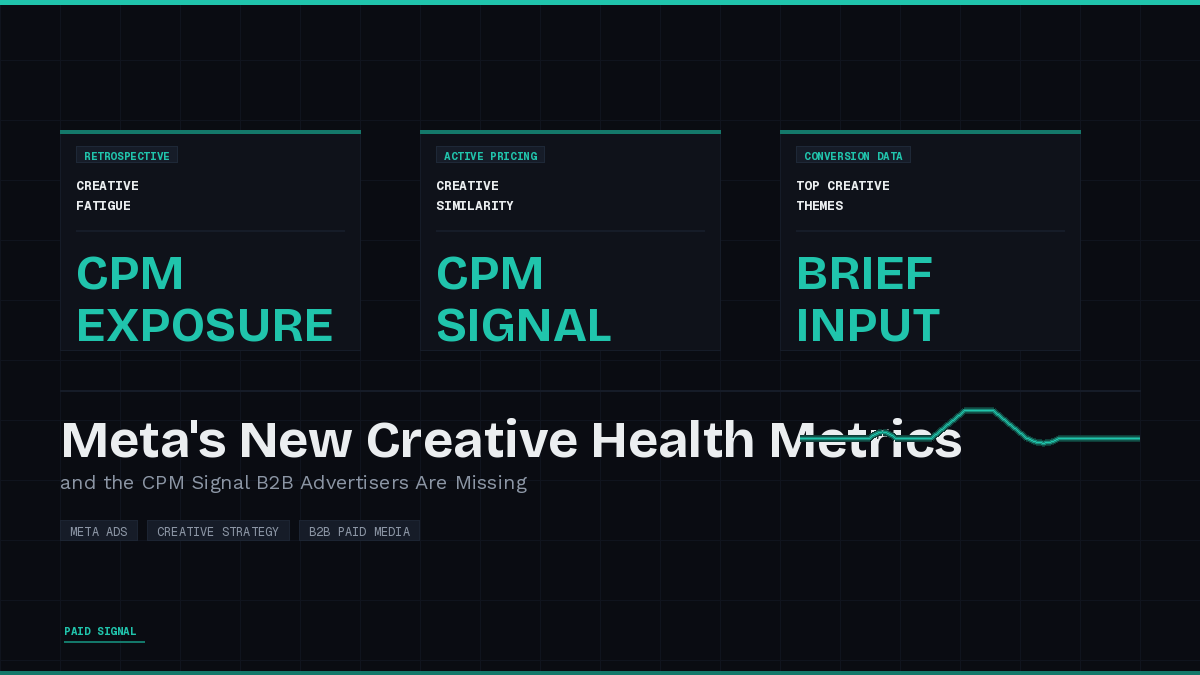
Meta rolled out three new metrics in Ads Manager this month: Creative Fatigue, Creative Similarity, and Top Creative Themes. Find them in the Breakdown menu.
Two of them are diagnostic. One of them is a pricing signal that's affecting your CPMs right now.
Here's what each one measures, why Meta built them (which is a different question), and the exact audit to run this week.
What the Three Meta Creative Health Metrics Actually Do
Creative Fatigue tracks CPM increases tied to ad repetition. When a user has seen the same ad enough times that engagement drops, the platform reads the decline as low relevance and moves your ad to lower-quality inventory. More expensive inventory, lower performance. Creative Fatigue is retrospective. It flags ads that have already declined. By the time it surfaces, you've been overpaying for a week or more. If you want to automate the pattern check across all active ad sets, Manus AI in Meta Ads Manager can surface fatigue signals without a manual comparison.
Top Creative Themes shows which angles are generating conversions in your account. Not CTR. Not impressions. Conversions. For B2B advertisers who've been rotating the same three value props for two quarters, this metric cuts through the internal debate. It tells you which creative framing your actual buyers responded to. Use it before any creative brief.
Creative Similarity is the one that matters most right now. It measures how diverse your active creative library is across ad sets. If you're running four ads and three use the same format, similar copy structure, and the same visual treatment, the platform scores your account as low on creative diversity.
That score translates to higher CPMs.
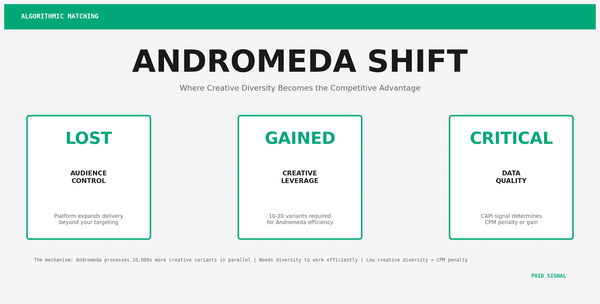
The mechanism: Meta's Andromeda algorithm matches users to ads in real time and handles a much larger number of ad variants in parallel than the prior system. It needs variety to work efficiently. When your creative pool is thin, Andromeda has fewer distinct signals to match against your audience. You pay more per impression because the algorithm is working harder to place something relevant with less to choose from.
Meta has not published an exact CPM penalty rate for high Creative Similarity scores. The mechanism is confirmed. The magnitude varies by account. Practitioners are reporting CPM increases in the 10 to 25 percent range on high-similarity accounts, though these figures aren't independently verified. Treat that as a directional signal, not a benchmark.
Why Meta Built These Metrics
The straightforward explanation is that Meta built these metrics to help you improve your account performance. Which is true.
The fuller explanation: Meta needs your account to have diverse creative because Andromeda depends on it. When your account has low creative diversity, Andromeda under-performs, which is bad for Meta's revenue metrics. If Creative Similarity penalizes your CPMs, you're either going to add creative diversity (which is what Meta wants) or spend more money for the same results (which Meta also benefits from).
That incentive structure doesn't mean the advice is wrong. Creative diversity does improve Andromeda's matching. The fix does benefit you. But it's worth knowing that Meta has a direct financial interest in you responding to a high Creative Similarity score by producing more creative.
The platform benefits here. So does the advertiser, if the response is adding actual creative variety and not just minor copy swaps.
The B2B Creative Diversity Problem
Most B2B advertisers have a structural creative problem that Creative Similarity will expose immediately.
The B2B creative process is slow. Legal reviews claims. Brand approves visuals. Product signs off on messaging. The result is typically one or two polished ads per campaign: a hero creative with a variant or two that swaps copy over the same visual treatment. The organization treats this as responsible process. Andromeda treats it as a low-diversity signal and prices accordingly.
The fix is not "make more ads." The fix is building creative structure that produces variation within the constraints your organization actually has.
Here's what counts as meaningful diversity to Andromeda: different opening hooks on video (i.e. the first three seconds, before a user can skip). Different problem framing in headlines (cost-focused vs. time-focused vs. risk-focused). Format variation across the same message (static image vs. single video vs. carousel). Different social proof types (data point vs. testimonial vs. case study outcome).
Here's what doesn't count: same image, different CTA button color. Same video, different caption text. Minor copy swaps with no structural difference in the ad. These don't give Andromeda meaningfully different signals to work with.
For B2B, a realistic creative pool looks like this: pick three MOFU messages that Top Creative Themes tells you are actually working. Build two or three executions per message. That's six to nine variants. Add two format variations and you're at eight to twelve. That's enough. You don't need a production sprint. You need a structured creative brief that generates variety, not just volume.
What This Means for Your Pipeline
Higher CPMs on an account with low Creative Similarity mean the same budget produces fewer impressions. Fewer impressions at the same conversion rate means fewer qualified opportunities. The pipeline math compounds.
If your CPMs are elevated 15 percent because of Creative Similarity and you're running a $20K/month MOFU program, you're effectively running an $18K program and paying $2K for inefficiency. That $2K either goes to waste or comes out of pipeline reach.
This also affects how you should think about creative investment. A $500 production run that generates three or four meaningfully different creative variants will often produce better CPM efficiency than spending that same $500 on a premium polish pass of a single ad. Not always. But often enough to test.
The platforms are automating targeting and bidding. The human advantage is shifting to creative quality and creative volume. Creative Similarity makes that shift visible in a way it wasn't before. It's now a measurable variable with a price tag.
The Audit to Run Before Your Next Campaign Meeting
Three steps. Takes fifteen to twenty minutes.
Step 1: Pull Creative Similarity. Go to Campaigns in Ads Manager. Add the Breakdown by Creative Similarity. Flag any ad set scoring high. Count how many distinct creative variations are active. If it's under four, that's where you start.
Step 2: Check Creative Fatigue on anything running more than thirty days. Evergreen creative is fine. Evergreen creative without rotation for thirty or more days is a CPM problem. If fatigue is flagging, either add new variants or pause the ad.
Step 3: Export Top Creative Themes before your next creative brief. Note the top three themes. That's your brief. Not what your product team thinks is the best message. What your buyers responded to.
If Creative Similarity is flagging, the short-term fix is adding three or four creative variations to your current active ad sets. Different hooks or formats of your best-performing existing creative. Don't wait for a full brief and an approval cycle. Use what you have. The goal this week is improving the diversity signal.
Run the audit. Add variants. Check CPMs after seven days. If they've moved, you've confirmed the signal in your account.
That's the test. Platform says Creative Similarity raises CPMs. Verify it in your account before adjusting your full creative strategy around a claim you haven't confirmed for your specific audience.
The Positioning Shift to Note
Meta framing these as "creative health" metrics is a specific positioning choice. Health implies you're being taken care of. What's actually happening: the platform is becoming more explicit about the optimization inputs it needs from you, and what you'll pay when you don't supply them.
This is the direction automated ad platforms are going. Less manual control over targeting and bidding. More transparency about what the automation needs to work. Creative diversity is one input. Data quality (CAPI, pixel hygiene) is another. Post-click conversion flow is a third.
If you're thinking about where the advertiser's competitive advantage lives in a world where Meta handles audience matching and bid optimization automatically, this is one of the clearest signals yet. The platform handles the distribution logic. You control the creative inputs, the data quality, and what happens after the click.
Creative Similarity just gave that a price tag.
Paid Signal covers what's actually changing in B2B paid media on LinkedIn and Meta. Practitioner-first, no vendor spin. Twice a week.