TripleDart's 2026 SaaS PPC Benchmarks: Three CPL Numbers Worth Using Carefully
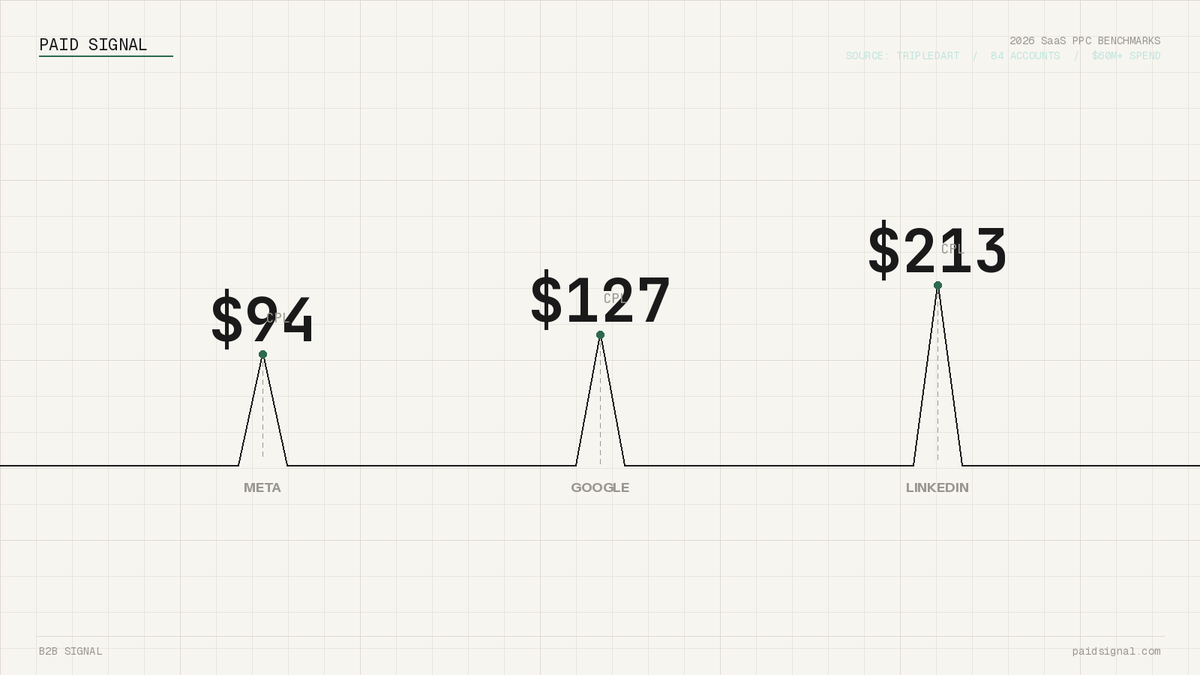
Meta CPL at $94. Google at $127. LinkedIn at $213. That's the headline. The method matters as much as the number.

TripleDart published their 2026 State of SaaS PPC Benchmark Report yesterday. It is one of the more substantive benchmark datasets that has come out this year: 84 Google Ads accounts, $60M+ in managed spend, six B2B SaaS verticals. Real account data, not a survey.
The headline numbers: Meta CPL at $94. Google at $127. LinkedIn at $213.
Before those numbers go into your next planning deck, you need to understand what they measure and what they do not. The data is useful. The context is what separates a good benchmark from a bad one.
What the Numbers Say
| Platform | Cross-Platform CPL |
|---|---|
| Meta Ads | $94 |
| Google Ads | $127 |
| LinkedIn Ads | $213 |
The spread across platforms is not surprising. LinkedIn charges a premium for professional targeting precision. Google reflects higher commercial intent. Meta is the cheapest reach you can buy for a B2B audience, even when you're paying for a conversion event.
What is useful about this data is that it comes from a single managed portfolio, which removes one layer of self-selection bias. Survey benchmarks aggregate responses from teams with wildly different definitions of what counts as a lead. Portfolio data at least uses consistent campaign mechanics across the accounts.
For B2B SaaS teams trying to answer "are our CPLs in the right range," these numbers give you a starting reference point by platform. That is the legitimate use case.
The Two Problems With This Data
Problem one: it is agency data from a single source. TripleDart manages these accounts. They have direct incentive to present strong performance numbers because those numbers reflect on their practice. This is not a reason to dismiss the report, but it is a reason not to treat it as neutral third-party research. Every benchmark from an agency comes with this structural conflict. Refine Labs, Metadata, TripleDart. They all publish this data. They all have the same incentive structure.
The better benchmark datasets are either peer-reviewed, verified by a third party, or aggregated across agencies with different methodologies. This is one agency's book of business. It reflects which clients they win, which verticals they specialize in, and how they structure campaigns.
Problem two: CPL is not the right metric. The report tracks cost per lead. For most B2B SaaS companies, that number is a checkpoint, not the outcome. Cost per qualified opportunity, cost per pipeline dollar created, and cost per closed deal are the metrics that tell you whether paid media is working.
A $94 Meta lead that closes at 0.5% is not cheaper than a $213 LinkedIn lead that closes at 4%. The CPL math only works when you control for lead quality, which requires pipeline data. The TripleDart report does not include pipeline or cost-per-opportunity tracking by their own disclosure.
This is not unusual for benchmark reports. Pipeline data is hard to collect, slow to resolve, and varies enormously by ACV, sales cycle length, and how each company defines an opportunity. But the absence of it is the most important caveat in the entire report.
What to Do With These Numbers
Use them to sanity-check platform-level CPL performance. If your Google CPL is $400 against a benchmark of $127, that is a signal to audit your keyword targeting, landing page conversion rate, and bid strategy. If your Meta CPL is $65 against a benchmark of $94, you are either buying cheap traffic or running an unusually efficient account. Both are worth understanding.
Do not use them to justify channel selection without pipeline data. "LinkedIn CPL is $213 so we should shift budget to Meta at $94" is incomplete reasoning. The question is cost per qualified opportunity, not cost per form fill.
Do not apply these directly to your ACV. TripleDart's portfolio skews toward specific SaaS verticals and deal sizes. A $30K ACV product in a technical vertical runs very differently from a $200K enterprise deal. If your deal economics are far outside the median B2B SaaS range, the benchmark has limited relevance.
The Test Worth Running This Week
If you are not already tracking from platform CPL through to pipeline by channel, set that up before the next budget review.
The setup is straightforward: pull your lead volume by platform for the last 90 days, match it against your CRM by source, and calculate cost per qualified opportunity for each channel. You do not need a complicated attribution model. You need first-touch or last-touch opportunity data broken out by platform.
Once you have that number, the TripleDart CPL benchmarks become useful as the first step in a more complete comparison. Without it, you are comparing cost at the wrong point in the funnel.
One B2B SaaS team running Google at $115 CPL with a 12% lead-to-opportunity rate is paying roughly $960 per qualified opportunity. Another team at $90 CPL with a 3% lead-to-opportunity rate is paying $3,000 per opportunity. The second team's CPL looks better against the benchmark. Their actual performance is worse.
Run your own math. Use the benchmark to see if you are in the range. Use your pipeline data to decide what to do about it.
Paid Signal covers what's actually changing in B2B paid media on LinkedIn, Meta, and Google. Practitioner-first, no vendor spin. Twice a week.