The Andromeda Shift: Where B2B Competitive Advantage Lives Now
Meta's Andromeda automation is shifting where B2B advertisers actually compete. It's not about bidding or audience targeting anymore. Here's where the human advantage moved.

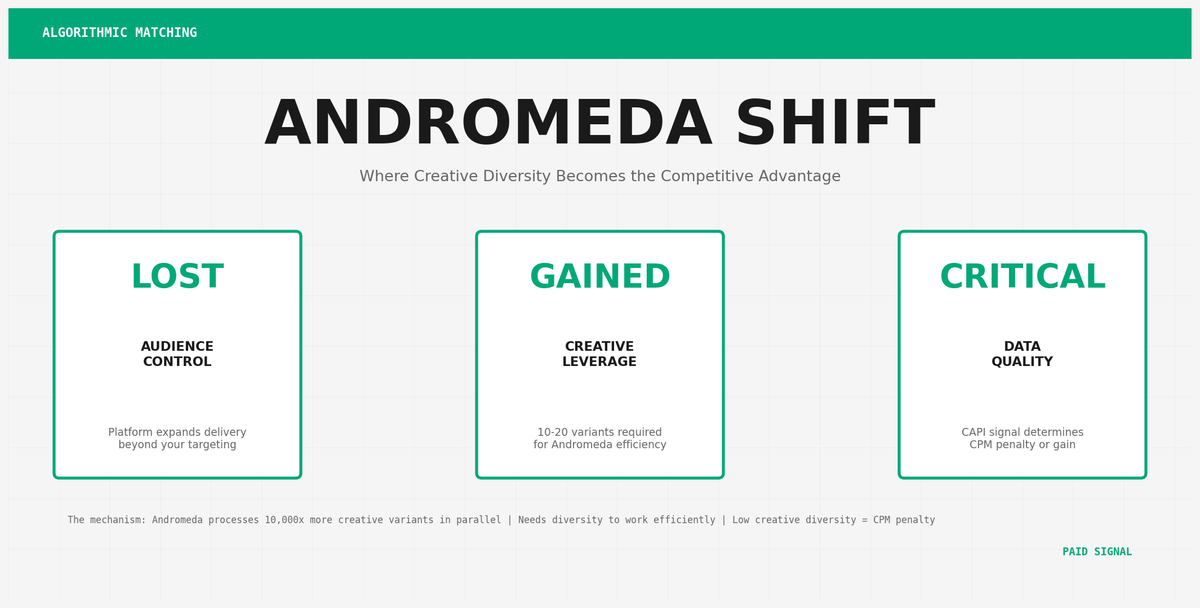
Meta shipped Andromeda in late 2025. It's a retrieval algorithm running on NVIDIA GH200 chips that processes 10,000x more ad variants in parallel than the prior system. The platform now handles 100x more combinations of creative, audience, and placement in real time.
This is not incremental automation. This is the platform making decisions about audience matching that you used to make manually. The question worth asking is not whether Andromeda is smarter. It is: what does the advertiser actually control now?
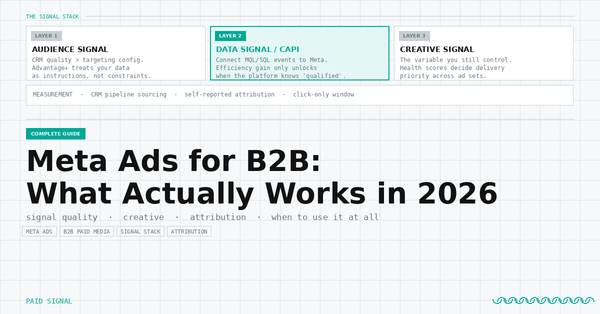
The answer is narrower than most teams think. And that narrowness is where the competitive advantage shifted. This post breaks down the three shifts: what you lost in audience control, what you gained in creative leverage, and how data quality becomes the leverage point that still lives in your hands. It's part of the larger Meta Ads for B2B signal stack framework.
What Andromeda Actually Does (And Why It Matters)
Andromeda is a retrieval system. Think of it as a matching problem: given a user about to see an ad slot, which ad from your account is most likely to drive the outcome you want?
In the old system, you pre-selected the audience. You said "reach 25-54 year old managers at software companies." Meta showed them ads. Andromeda flips this. You provide broad creative and audience inputs. Andromeda decides which specific person sees which specific ad variant.
The mechanism matters. Andromeda doesn't think about audiences in the way you do. It thinks about signals: what words appear in your ad, what visual treatment you used, what audience behavior patterns match your past converters. It then generates a match score for every combination.
When you have five ad variants, Andromeda can generate match scores for five combinations per user. When you have twenty variants, it can generate twenty. Scale that across millions of users per day, and the system confidence in its matches changes. More variants means more signals. More signals means better targeting.
This benefits the platform first. Better targeting means higher-quality inventory. Better inventory means higher clearing prices. That revenue calculation is Meta's incentive. The fact that it also benefits the advertiser is secondary.
But it does benefit you, if you understand what changed.
What You Lost: Manual Control Over Audience Targeting
Advantage+ Campaigns now treat detailed targeting as suggestions, not constraints. If you want true manual control, you have to build it. Most teams don't. Most teams take the default.
This means your audience scope is broader than you probably think it is. You're relying on Andromeda to find your buyer in a wider pool than you used to search.
For MOFU and BOFU campaigns running to lookalike or retargeting audiences, this is usually fine. You've already filtered to high-intent signals. Andromeda will find converters within that group.
For TOFU demand creation campaigns, this is where the platform and your interests diverge. You want awareness among a specific persona. Meta wants scale and placement fill. Andromeda will broaden your reach to "similar to people who showed some intent signal." Similar is looser than you'd probably define it.
The shift: you lost audience precision. The platform calls this "audience expansion." That's accurate. Whether it helps your pipeline depends on your offer and your ICP clarity.
What You Gained: Creative Becomes The Lever
This is the real shift. With Andromeda doing the matching, creative diversity became the input that determines performance.
When creative was a secondary input and targeting was primary, you could run 3-5 ads and optimize your audience layers. That strategy is expired.
Now, 10-20 creative variants across different hooks, formats, and social proof types are the minimum to let Andromeda work efficiently. Not because you need that many for human consumption. But because Andromeda needs variety to distinguish signals.
Think of it this way: Andromeda is looking for patterns in what drives conversion. If all your creative uses the same visual treatment, the same copy structure, and the same value prop angle, you're giving it one signal repeated five times. That looks like noise to a matching algorithm. It looks like you don't have much to choose from.
But if you have five distinct visual treatments, three different problem framings, and two different social proof types, you've just gave Andromeda ten different signals to match against intent signals in your audience. That's useful variance.
Meta's internal testing shows 32% CPA reduction when accounts shift from tight targeting plus 3-5 variants to broad targeting plus 20+ variants. That's directional, not gospel. But the direction is clear.
The Creative Similarity Tax
This is where theory hits your P&L. Creative Similarity is a metric Meta added to Ads Manager in early 2026. It scores how diverse your ad library is.
High Creative Similarity means your creative is repetitive. Low Creative Similarity means it's diverse. The penalty: high similarity scores raise your CPMs. The range practitioners report: 10-25% CPM increases on high similarity accounts. This is one of three creative health metrics Meta uses to optimize delivery. For the full breakdown of what each metric measures and how they connect to performance, see Meta Creative Health Metrics: What B2B Advertisers Need to Check Right Now.
The mechanism is real. The exact penalty rate varies by account. But the principle is consistent: Andromeda needs variety to work efficiently. If you don't provide it, the system treats your inventory as lower quality and prices accordingly.
For a 20K per month MOFU budget, a 15% CPM increase is 3K in inefficiency. That either goes to waste or reduces your reach by a quarter.
The fix is not perfection. It's structural variety. Three distinct messages. Two to three executions per message. Different formats when possible. Different visual treatments. Different social proof types.
For most B2B teams, this means building a creative framework instead of making ads one at a time. A brief that says "test three problem framings across two visual treatments and three social proof angles" produces 18 variants by design, not by accident. That's enough.
The CAPI Connection: Data Quality Feeds The Algorithm
Andromeda's matching confidence depends on signal quality. The stronger your conversion data, the better the matches.
This is where Conversion API data quality becomes a performance variable. CAPI hygiene used to be a nice-to-have. Now it's a leverage point.
If your CAPI is sending noisy data (conversion events that aren't actually conversions, misaligned timestamps, incorrect currency values), Andromeda sees low-confidence conversion patterns. When pattern confidence is low, the algorithm falls back to broader audience matching. Broader matching is less efficient. CPMs rise as a result.
This doesn't happen overnight. But over a 30-60 day period, if your CAPI is sloppy, you see the creep in CPMs. The platform is working harder to find a pattern in unclear data.
Audit your CAPI implementation before scaling budget to Andromeda-dependent campaigns. Check timestamp alignment. Verify that conversion events map to actual buyer intent. Run a separate test with clean CAPI data and dirty CAPI data on the same audience. Watch CPMs and conversion quality diverge. CAPI is the foundation of the signal stack: Meta Advantage+ Leads for B2B: Why CAPI Is the Gate to the Efficiency Gain covers the full setup and why it matters for algorithm performance.
Where The Human Advantage Moved
Andromeda handles audience matching and bid optimization. You don't need to do that anymore. The platform is faster at it than you could ever be.
Where you still win: creative strategy, post-click experience, and data quality.
Creative strategy means ideation. Andromeda can match an ad to a user. It cannot decide what problem frame will resonate with your ICP. That's still a human insight.
It means building a creative framework that produces variety by design, not volume by accident. Most teams understand "make ten ads." Few understand "make three distinct concepts, and execute each with two different visual treatments and three social proof angles." That structure is the human edge.
Post-click experience still matters. Andromeda drives clicks. What happens after the click is your responsibility. A poor landing page experience will tank your conversion rate no matter how good Andromeda's matching is. The platform can't see past the click.
Data quality is still your leverage point. Andromeda relies on conversion data. If you're disciplined about CAPI implementation, pixel firing, and conversion event definitions, you're feeding the algorithm better signals than competitors who treat it as infrastructure. That compounds.
The Honest Assessment
Andromeda shifts your competitive advantage from targeting and bidding to creative production and data quality. This is good if you have creative resources and discipline. It's bad if you don't.
Most B2B teams are not set up for 20+ variants per campaign. Legal, brand, and product approval cycles are slow. In-house production is limited. Agencies are expensive.
The teams that will win in 2026 are the ones that restructure their creative workflow around this reality. Not overnight. But intentionally.
That means either: building an in-house rapid creative system that produces variants in days instead of weeks. Outsourcing creative production to a service that understands creative diversity as a performance lever. Or accepting a competitive disadvantage and running tighter budgets on fewer campaigns.
The platform does not care which path you choose. But it will price you based on your choice.
What To Test This Week
Three steps. 30 minutes.
Step 1: Check your Creative Similarity score. Go to Campaigns in Meta Ads Manager. Add a Breakdown by Creative Similarity. Flag any campaign scoring above 50. Count how many distinct creative variants are active. If you're under ten, that's where the CPM penalty is coming from.
Step 2: Audit your CAPI implementation. Pull the last 100 conversion events from CAPI. Verify that every conversion event you're sending actually represents buyer behavior you care about. Check timestamp alignment. If you find timestamp drift, conversion event overlap, or loose definitions, your CAPI is feeding Andromeda noisy signals.
Step 3: Pick one MOFU campaign and test creative diversity. Run it with your current creative count and CAPI implementation for 14 days. Document CPM, CPC, and qualified conversion rate. Then add 5-8 new creative variants with different visual treatments or problem framings. Keep audience and budget the same. Run for another 14 days.
Compare the two periods. If CPMs dropped and qualified conversions increased, you've confirmed the signal in your account. If nothing changed, your creative similarity was not your bottleneck.
Run the test. See what the data says. Don't assume the platform mechanics apply to your specific account until you've verified it.
That's the honest way to decide whether Andromeda is a tool to work with or a constraint to work around.
What's changing in B2B paid media. What it means for your pipeline.